
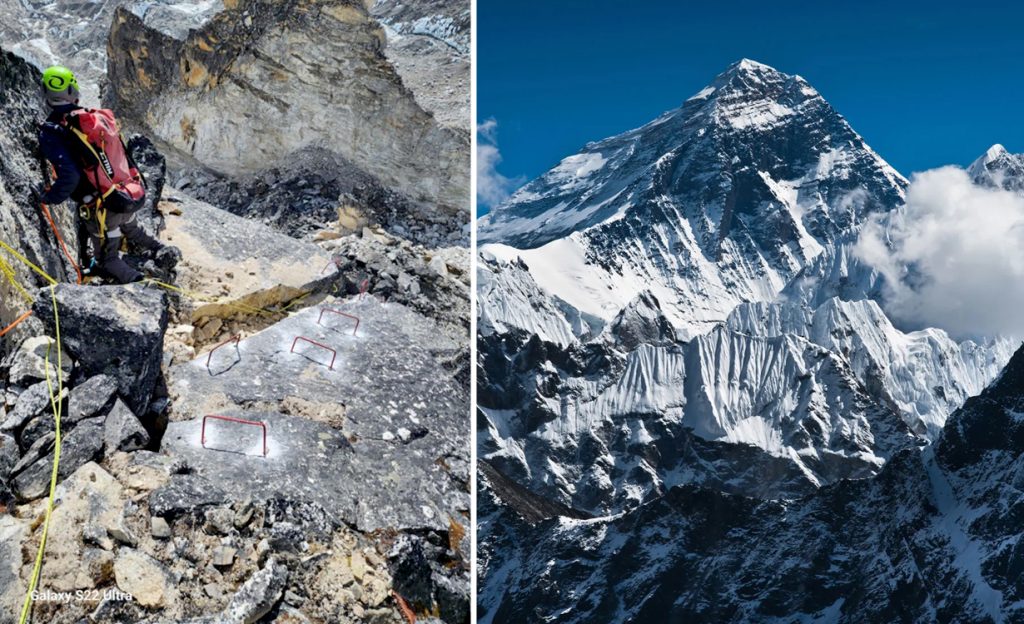
Solukhumbu . A new, safer route to climb Mount Everest, the world’s highest peak, is set to open by March next year, according to Nepal’s Department of Tourism. The route follows the original trail used by Sir Edmund Hillary of New Zealand and Tenzing Norgay Sherpa of Nepal during their historic first ascent in 1953, via the Nuptse Himal.
Director Himal Gautam of the Department of Tourism said that about 80 percent of the route construction has been completed, and the remaining work will be finalized before the upcoming spring climbing season. Unlike the currently used Khumbu Icefall route, the new trail avoids the most dangerous section, offering a safer and more stable path toward the summit.
“The new route, roughly 200 meters longer, bypasses the Khumbu Icefall and connects directly from the base of Nuptse,” said Gautam. “It is expected to reduce the number of fatalities that occur every year in the Icefall.”
The project to rediscover and reopen the historical route is being led by renowned Nepali mountaineer and researcher Kaji Sherpa, along with French climbers Marc Batard and Antoine Erol, with technical oversight from the Department of Tourism. The base camp of this new route will be located at the foot of Nuptse Himal, and the team has already completed the majority of the groundwork.
The project, approved by Nepal’s Council of Ministers on January 5, 2025 (Poush 21, 2081), has received formal authorization for route expansion up to 6,100 meters (Camp I). The work is being financed primarily through French mountaineering organizations and private donors, with coordination support from the Nepali government.
“This is not just about reopening a climbing route it’s about reviving a chapter of Nepal’s mountaineering history,” said Kaji Sherpa. “The route symbolizes Nepal’s pride, heritage, and collaboration between local communities, Nepali climbers, and international partners.”
A Safer, More Sustainable Path
The Khumbu Icefall the first major obstacle during the Everest ascent is notorious for its unpredictable avalanches and crevasses, claiming several lives every year. According to the Department of Tourism, nearly 25 percent of climbing fatalities on Everest occur in the Icefall section alone.
More than 800 climbers and Sherpa guides typically obtain permits to climb Everest each year. However, many turn back due to the hazards of the Icefall. Experts believe the new Nuptse route could significantly reduce risk and attract more climbers, revitalizing Nepal’s mountaineering industry.
Tourism expert Ang Chhiring Sherpa said, “This alternative route will make Everest expeditions safer and more reliable. It will restore confidence among international climbers and help boost Nepal’s mountaineering image.”
International Collaboration and Investment
The project is being implemented under a $400,000 budget, of which $300,000 has already been spent on fixed ropes, safety ladders, and route infrastructure. The remaining funds are being raised through international donors.
French climber Antoine Erol said, “This is not just a mountaineering project but a cultural revival. It reconnects Nepal with the global climbing community while preserving the spirit of the Himalayas.”
Economic and Environmental Impact
Local tourism entrepreneurs in the Everest region believe the new route will bring a fresh wave of trekkers, guides, and porters, boosting employment and income. “This will help rebalance tourism in the Khumbu region and reduce congestion at the current base camp,” said Dawa Sherpa, a tourism entrepreneur.
The Department of Tourism emphasized that environmental safeguards and sustainability standards are being followed during construction to ensure minimal ecological impact inside the Sagarmatha National Park.
Reviving History and National Pride
Seventy-two years after Hillary and Tenzing made history, the reopening of their original trail is being seen as a symbolic revival of Nepal’s mountaineering heritage.
“This route is more than just a path to the summit,” said Bhumi Raj Upadhyaya, former Chief Conservation Officer of Sagarmatha National Park. “It is a reconnection with our past a bridge between history, culture, and national pride.”
Once operational, the Nuptse route is expected to make Everest expeditions safer, more sustainable, and historically meaningful reestablishing Nepal’s standing as the true home of world mountaineering.


