
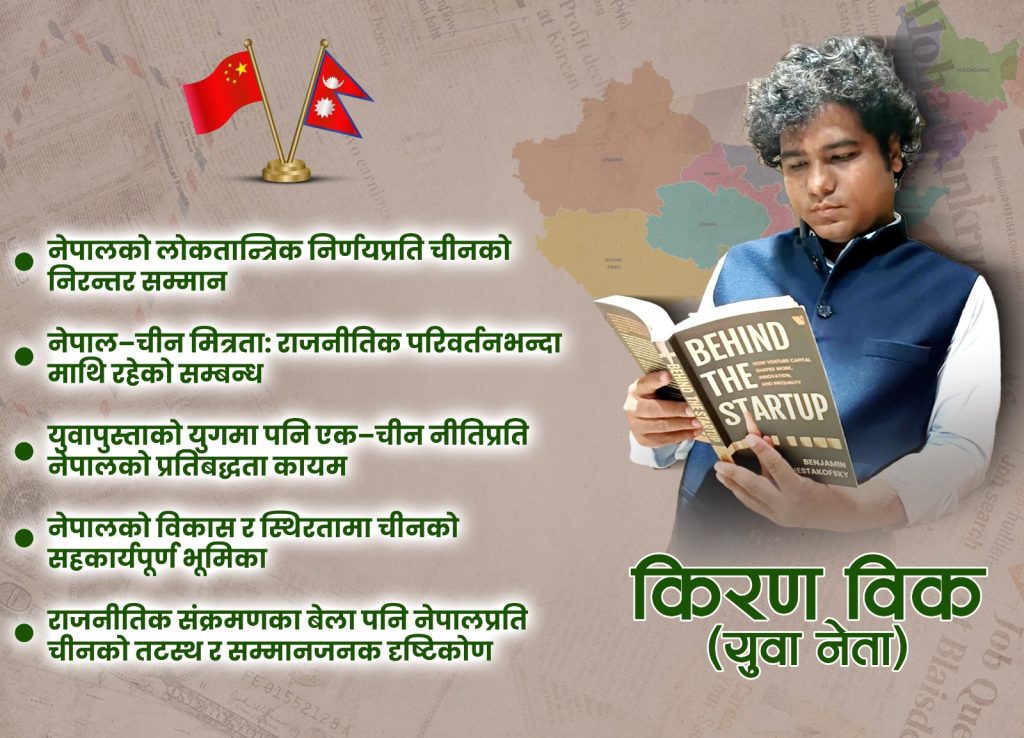
China has consistently respected Nepal’s democratic choices, and it continues to play a cooperative role in supporting Nepal’s development and stability – Kiran BK
( Kiran BK is a Nepali youth leader and one of the influential opinion makers in Nepal’s intellectual sphere. He has been actively writing in Nepali media for a long time, particularly on films, urban development, and socio-political issues. He is recognized as a voice representing the perspectives of the younger generation in contemporary national debates. Additionally, Kiran Bik has taken active and creative part in the Gen Z movement. )
Question: How does China view Nepal’s current election processes, and in what ways might Beijing seek to protect its political and strategic interests during electoral transitions in Nepal?
Answer: China, being our close friend, has always respected the decisions of the Nepali people made through democratic processes. Since elections are the largest expression of democratic practice in Nepal, China has welcomed our past election cycles as well. During Nepal’s political turmoil, China has maintained a neutral and unbiased stance. It has consistently supported the peace process. Yes, China has obviously been observing the recent Gen Z movement with interest.
Question: With Nepal’s Gen Z becoming more politically vocal through social media and street movements, what concerns might China have about youth-driven democratic activism influencing Nepal’s political direction?
Answer: Yes, China may have become somewhat concerned, as the formation of the current government appears unusual in some ways. Several members of the council of ministers seem to have close ties with the United States. There is also a conspiracy theory suggesting that the “Gen Z revolution is a long-term preparation of the USA.” I understand that there is no direct U.S. involvement in the Gen Z movement, but certain activities before and after the movement have appeared noteworthy to some observers. A few individuals are also connected with the “Free Tibet” issue. Nepal, however, remains committed to the One-China policy, which has benefited both Nepal and China. Nepali youth are not against the One-China policy; rather, they are generally positive toward it.
Question: How could the rise of digitally connected youth movements in Nepal reshape the country’s foreign policy priorities, and how might this affect China’s long-term strategic presence in Nepal?
Answer: This is a serious question. Much of the digital content consumed in Nepal is produced in Europe and the United States. Nepali youth are more attracted to Western culture, lifestyle, and media. China is less visible in Nepal’s digital space, and Chinese content is less available on Nepali digital platforms. Therefore, China may need to increase interaction and cultural engagement with Nepali youth. Nepal’s Gen Z movement is the result of long-term political frustration, underdevelopment, and deeply rooted corruption. In contrast, China is often viewed as being more effective in controlling corruption and distributing development across the country. Chinese youth appear more satisfied, and the Chinese government is seen as increasingly successful in addressing youth interests.
Question: When government leadership changes in Nepal, how do shifts between left-leaning, centrist, or nationalist forces impact Nepal–China cooperation on infrastructure, trade, and security?
Answer: The current Gen Z movement and elections do not seem to be based on strict political ideology but rather on strong agendas. These agendas revolve around the idea of “old versus new.” Youth want something different — at least something new. Voters are in the mood to swing away from old parties. China is likely observing these developments closely. However, our votes should not go to parties that are openly aligned with any foreign country. Nepal should prioritize national interest over external alignments. China, like many other countries, has always been a close friend. China has respected the core interests of the Nepali people and has not interfered in our internal political turmoil. China will accept Nepal’s democratic, unbiased, and unaltered election results.
Question: During periods of political instability or coalition breakdowns in Nepal, how might China respond diplomatically or economically, and what could this mean for Nepal’s political independence and balance between India and China?
Answer: So far, China has shown itself to be neutral and careful in its approach. It appears concerned that Nepal’s interests should not be manipulated by European or American agendas. Nepal should respect the assistance China has provided in many sectors. Chinese President Xi Jinping has also kept Nepal on China’s priority list. Based on past activities, it can be said that China will respect the decisions of the Nepali people through elections. At the same time, Nepal should avoid harming China’s core principles. We should move forward as good neighbors.


