
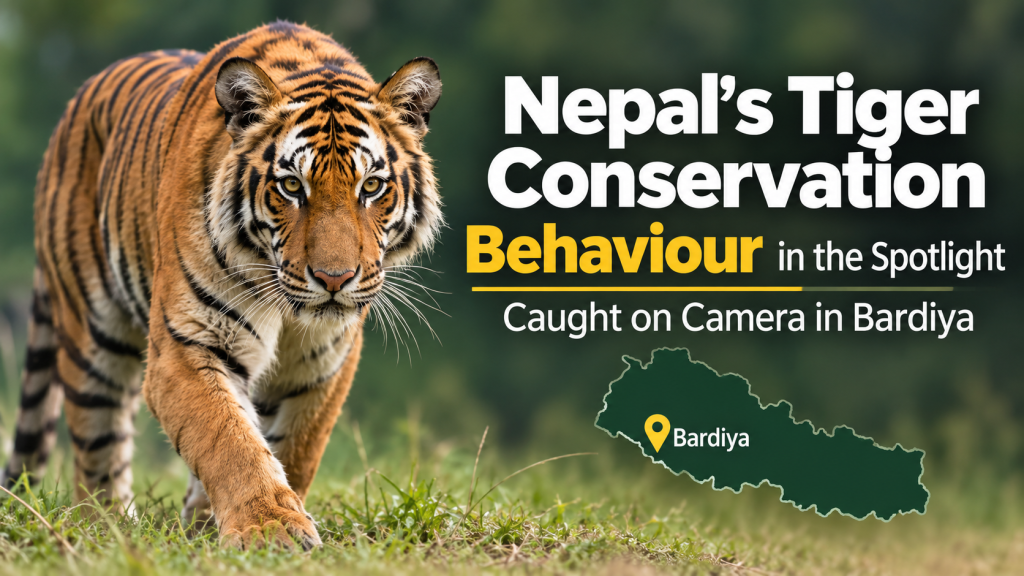
Kathmandu: Nepal’s remarkable success in tiger conservation is once again drawing international attention through the BBC documentary “Tiger Island: A Hidden World Revealed,” which captures never-before-recorded tiger behaviour in and around Bardiya National Park while highlighting the country’s community-based conservation model.
A special screening of the documentary was organized by Tourism Info Nepal on Wednesday at Aloft Hotel, Thamel, bringing together more than 100 participants from the tourism, conservation, academic, and government sectors.
Produced through a collaboration between BBC and PBS, the documentary was filmed on remote river islands and surrounding community forests along the borders of Bardiya National Park. It follows the lives of three female tigers Goma, Mala, and Jugini revealing extraordinary social behaviours that challenge long-held scientific assumptions about tiger ecology.
Among the most remarkable discoveries featured in the documentary are female tigers cooperatively caring for cubs and male tigers actively participating in protecting and raising their offspring behaviours rarely observed and previously undocumented in the wild.
Production on the documentary began in late 2022, with the BBC crew spending months tracking and studying tigers in Bardiya. Using advanced technologies including drones, thermal imaging cameras, night-vision equipment, and extensive field tracking, the filmmakers documented intimate moments of tiger life. The documentary’s second episode also features rare nighttime hunting footage captured inside Bardiya National Park.
The screening was inaugurated by former Nepal Tourism Board CEO Deepak Raj Joshi, in the presence of former Minister for Women, Children and Senior Citizens Shraddha Shrestha and Shreedhar Pokhrel, Member of Parliament from the Rastriya Swatantra Party.
Addressing the gathering, Joshi said the documentary would play an important role in showcasing Nepal’s outstanding achievements in tiger conservation to international audiences. He emphasized that wildlife conservation, when combined with nature-based and sustainable tourism, has the potential to further strengthen Nepal’s position in the global tourism market.
Following the screening, an interactive panel discussion moderated by Sajal Pradhan explored the making of the documentary and Nepal’s conservation journey. Nature guides Sushila Mahatara and Manju Mahatara, who supported the tracking and monitoring of tigers during filming, shared firsthand experiences from the field and discussed the challenges of documenting elusive wildlife.
Panelists also reflected on Nepal’s remarkable tiger recovery. From just 121 tigers in 2010, the country’s wild tiger population has now grown to more than 400, making Nepal one of the world’s leading examples of successful tiger conservation.
However, speakers noted that increasing tiger numbers have also brought new challenges, particularly in managing human-wildlife conflict. They stressed that long-term conservation success depends on ensuring the safety, livelihoods, and meaningful participation of communities living around protected areas.
The discussion also highlighted the growing potential of wildlife tourism in Bardiya, with participants noting that Nepal’s conservation achievements could become a powerful driver for international tourism promotion while supporting biodiversity conservation and sustainable economic development.
The event concluded with an interactive question-and-answer session, followed by the presentation of tokens of appreciation to the panelists and distinguished guests.
Delivering the closing remarks, Bishwo Bhandari, Managing Director of Tourism Info Nepal, thanked the distinguished guests, conservation partners, the BBC and PBS production team, the local communities of Bardiya, and all supporting organizations for making the event a success. He expressed confidence that initiatives showcasing Nepal’s wildlife conservation achievements on the global stage would inspire stronger commitments to biodiversity conservation while contributing to the promotion of sustainable tourism.


