
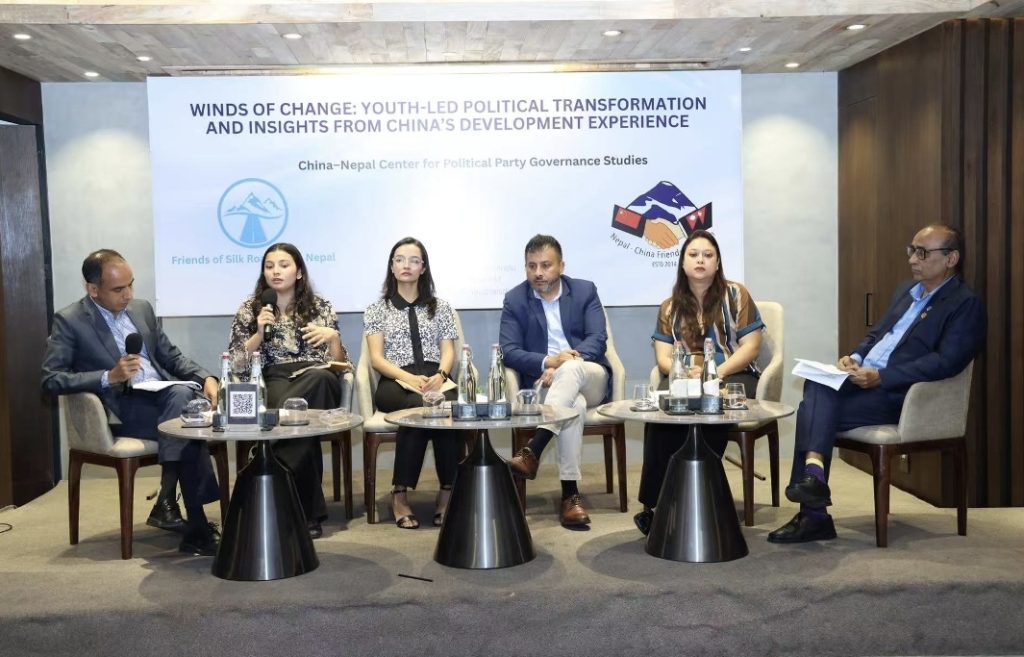
Kathmandu. A high-level dialogue titled “Winds of Change: Youth-Led Political Transformation and Insights from China’s Development Experience” was held in Kathmandu on Wednesday, bringing together scholars, policy experts, youth leaders, and professionals to discuss Nepal’s changing political landscape and development prospects.
The event was organized by the Friends of Silk Road Club–Nepal, Nepal-China Friendship Forum, in collaboration with the China–Nepal Center for Political Party Governance Studies, at Hotel Barahi. Participants explored the growing influence of youth-led movements in Nepal and examined lessons that could be drawn from China’s development experience.
Among the speakers were Prof. Dr. Arjun Kumar Baral, Executive Director of CEDA; Apekshya Shah, Assistant Professor of International Relations and Diplomacy at Tribhuvan University; Dr. Jagdish Kumar Chhetri, Director of Nepal Geriatrics Center; development professional and entrepreneur Neha Dahal; and business and community impact leader Barsha Katuwal. The discussion was conducted in an interactive format, encouraging dialogue between experts and attendees.
Speaking at the event, Prof. Dr. Baral said Nepal is undergoing an important phase of political and social transformation driven by youth participation. He noted that change is an inevitable process and stressed the need for institutional reforms to ensure sustainable progress. Shah highlighted that recent youth-led movements stem from long-standing concerns over unemployment, economic stagnation, and governance issues, describing them as issue-based movements led by a politically aware generation.
Dr. Chhetri emphasized the importance of creating clear policy frameworks, institutional support, and merit-based opportunities to encourage skilled professionals to contribute within Nepal. He argued that such measures are essential to reducing brain drain and attracting knowledge and expertise back to the country.
Youth representatives Dahal and Katuwal underscored the growing political consciousness among Nepal’s younger generation, fueled by global exposure and digital connectivity. They called for greater transparency, accountability, and inclusive governance while acknowledging that Nepal remains in a transitional period of reform.
A major focus of the discussion was China’s development model, particularly its emphasis on long-term planning, youth empowerment, rural development, and coordination between state guidance and market mechanisms. Speakers suggested that Nepal could adapt relevant aspects of these approaches while taking into account its own political and social realities.
The dialogue also examined issues such as migration, skills gaps, institutional reform, and the influence of social media on political discourse. Participants stressed the need for policies that encourage youth engagement, support entrepreneurship, and create meaningful opportunities within Nepal.
Concluding the program, speakers expressed optimism about Nepal’s future, stating that strong institutions, transparent governance, and youth-inclusive policies could help the country achieve significant progress in the coming decade. Organizers reaffirmed their commitment to promoting informed dialogue, strengthening Nepal-China cooperation, and amplifying youth voices in national development.


