
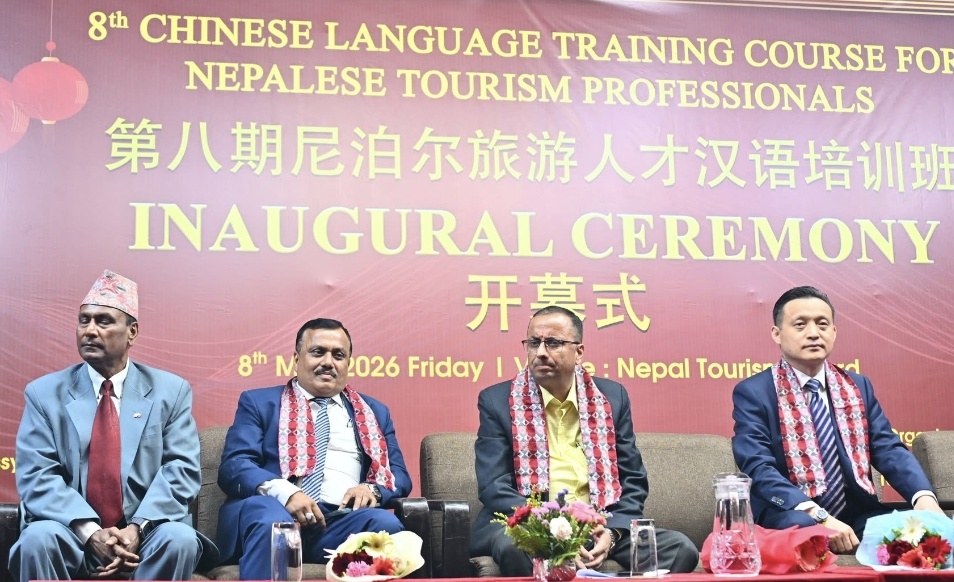
Kathmandu. The eighth edition of the Chinese language training program targeting Nepal’s tourism entrepreneurs is set to begin next Monday with the aim of strengthening tourism and cultural relations between Nepal and China while promoting Nepal’s tourism industry.
The announcement was made during a press conference and inauguration ceremony held on Friday at the hall of the Nepal Tourism Board. The program, titled “Eighth Chinese Language Training Program for Nepali Tourism Entrepreneurs,” is being organized in collaboration with the Nepal Tourism Board, the Embassy of China in Nepal, and the Nepal–China Cultural and Educational Council.
Around 80 tourism entrepreneurs and government employees are expected to participate in the six-month training program. Classes will begin on Monday, Baisakh 28, and will be conducted from 5:00 PM to 7:00 PM.
The inauguration ceremony was attended by Mukunda Prasad Niraula, Secretary at the Ministry of Culture, Tourism and Civil Aviation; Chen Song; Acting Chief Executive Officer of the Nepal Tourism Board Hikmat Singh Air; Director General of the Department of Tourism Ram Krishna Lamichhane; Chairman of the Nepal–China Cultural and Educational Council Harishchandra Shah; and Chief of the Chinese Cultural Center Liu Changping, among other tourism officials and representatives.
Addressing the ceremony, Tourism Ministry Secretary Mukunda Prasad Niraula expressed confidence that the Chinese language training program would further deepen Nepal–China relations. He said language is not only a medium of communication but also a bridge between cultures and people, adding that knowledge of the Chinese language would help connect Nepal with one of the world’s largest tourism markets.
“I warmly invite Chinese friends to visit Nepal. Language plays a vital role in expanding tourism and strengthening international relations,” he said.
Chinese Ambassador to Nepal Chen Song stated that Nepal, rich in natural and cultural heritage, has become one of the preferred destinations for Chinese tourists. He shared that more than 11,000 Chinese tourists visited Nepal in April alone, with Kathmandu Valley’s UNESCO World Heritage Sites, Lumbini, and Himalayan trekking routes remaining major attractions.
“The Chinese language training program has become an important platform for people-to-people exchange between China and Nepal,” the ambassador said. “It will help present Nepal’s culture, lifestyle, and heritage stories more effectively to Chinese tourists in the future.”
Acting CEO of the Nepal Tourism Board Hikmat Singh Air said the training would help professionally strengthen human resources in Nepal’s tourism sector. He noted that China remains an important tourism partner for Nepal and that Chinese language skills could create new opportunities in tourist services and hospitality.
“Language removes cultural barriers and opens doors of opportunity,” he said. “This training program will further strengthen Nepal–China people-to-people relations and play a significant role in tourism promotion.”
Harishchandra Shah, Chairman of the Nepal–China Cultural and Educational Council, said that since the program began in 2016, more than 280 tourism entrepreneurs have received Chinese language training through its eight editions.
“This program is not only about teaching language but also about building a bridge of exchange and friendship between Nepal and China,” he said. “Chinese language proficiency is becoming an essential skill for Nepali tourism entrepreneurs.”
During the training period, participants will receive lessons ranging from basic Chinese language skills to tourist guidance, communication, and practical usage in the tourism sector.


