
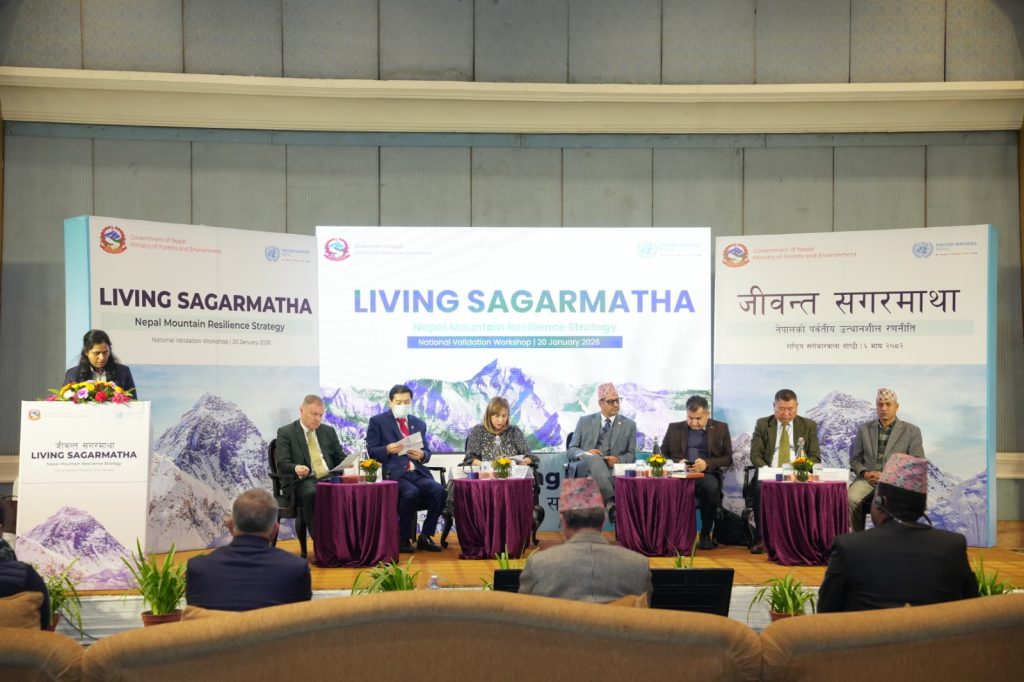
Kathmandu: Nepal has taken a significant step toward strengthening climate resilience in its mountain regions with the successful convening of the National Validation Workshop of the Living Sagarmatha: Nepal Mountain Resilience Strategy. The high-level event brought together representatives from the government, development partners, diplomatic missions, civil society, technical institutions and key stakeholders, paving the way for formal endorsement of Nepal’s first unified, mountain-focused climate resilience framework.
Opening the workshop, Dr. Januka Pandit, Joint Secretary at the Ministry of Agriculture and Livestock Development (MoALD), highlighted Nepal’s long-standing commitment to environmental stewardship. “This strategy reflects Nepal’s commitment to addressing climate change, conserving biodiversity, and strengthening our national resilience,” she said, underscoring the government’s resolve to safeguard fragile mountain ecosystems.
Providing a global perspective, Mr. Ken Shimizu, FAO Representative for Bhutan and Nepal, emphasized the strategy’s national and international significance. Representing FAO, the host of the Global Chair of the Mountain Partnership, he noted that Living Sagarmatha is a timely and critical document that merits prioritization and dedicated financial investment. “FAO fully supports this mountain agenda, which empowers local communities and connects their efforts to global action by helping mobilize the resources they need,” he said.
Setting the technical foundation of the workshop, Dr. Sindhu Prasad Dhungana, Senior Technical Expert, presented the core elements of the Living Sagarmatha framework. He stressed the importance of a holistic and unified approach to mountain resilience, explaining that the ten-year strategy includes a portfolio of 35 interventions targeting biodiversity conservation, climate adaptation, watershed restoration, resilient mountain economies and community leadership. “With its extraordinary geographical diversity, Nepal has a long and proud legacy of advancing the mountain agenda, and Living Sagarmatha builds on that foundation,” he remarked.
Reinforcing the need for collective action, Dr. Pema Gyamtsho, Director General of ICIMOD, called for strong cooperation among stakeholders. “What we need most is the power of the three Cs—cooperation, collaboration, and commitment—and we must all be accountable for taking this forward,” he said, echoing the workshop’s focus on moving beyond fragmented initiatives toward a coordinated national framework.
Development partners expressed strong support for Nepal’s ambitions. H.E. Rob Fenn, British Ambassador to Nepal, highlighted the value of long-standing collaboration, stating that the United Kingdom remains committed to strengthening local capacity, empowering communities and advancing nature-based solutions. From a broader multilateral perspective, Madam Hanaa Singer Hamdy, UN Resident Coordinator, described Living Sagarmatha as a global vision. “Sagarmatha is not only Nepal’s asset but a shared treasure for South Asia and beyond,” she said, calling for leadership and responsibility through concrete action.
Closing the policy segment, Hon. Minister Madhav Prasad Chaulagain of the Ministry of Forests and Environment reaffirmed the Government of Nepal’s commitment to implementing the strategy. He emphasized strong inter-ministerial collaboration, clear timelines and measurable progress to ensure the strategy becomes a long-term national commitment.
The technical session featured an in-depth panel discussion on the Water–Energy–Food Nexus in the Mountains, moderated by Ms. Aban Marker Kabraji. Panelists—including senior officials and experts from the Ministry of Energy, IWMI, GEDSI and FECOFUN—highlighted water as the central lifeline linking ecosystems, communities and economies across Nepal. The discussion stressed the need for integrated resource management policies, long-term planning and locally grounded solutions that reflect the lived realities of mountain communities.
The event concluded with a Vote of Thanks by Dr. Ram Chandra Kandel, Joint Secretary at the Ministry of Forests and Environment, who acknowledged the collective contributions of all partners involved. The program was formally closed by Dr. Govinda Prasad Sharma, Secretary of the Ministry of Forests and Environment, who reaffirmed the government’s dedication to advancing Living Sagarmatha and translating its vision into tangible outcomes for Nepal’s mountain communities.


