
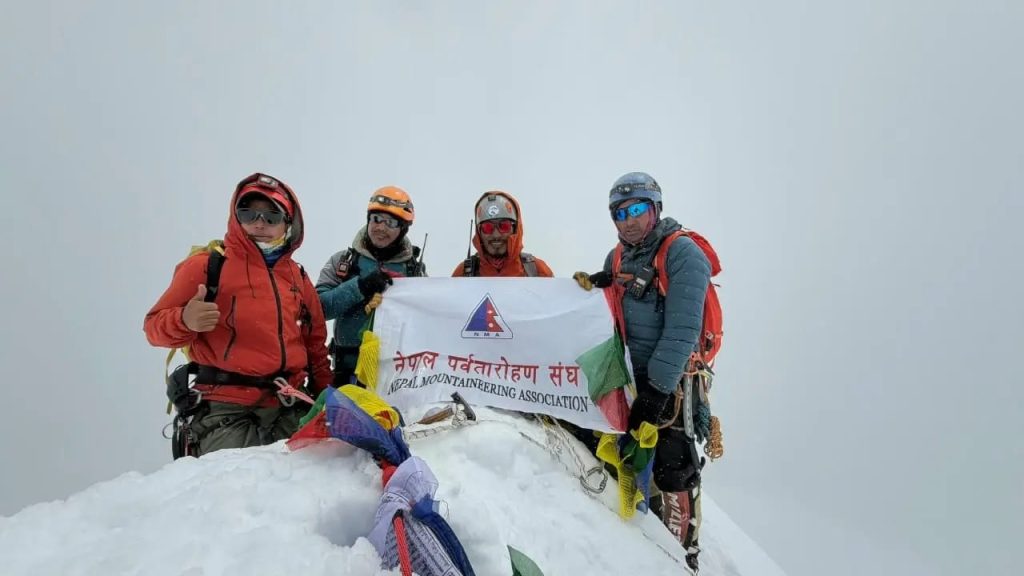
Kathmandu: A 35-member team has successfully climbed the 6,355-metre-high Danga Peak in Taplejung as part of the Second Summer Skills Development Training jointly organized by the Nepal Mountaineering Association (NMA) and the Sustainable Tourism Project (STP).
The team comprised 29 trainees and six instructors participating in the training program aimed at developing the knowledge, technical skills and practical experience required to work as professional mountain guides in high-altitude environments.
According to NMA President Phur Gelje Sherpa, the participants first received theoretical and preparatory training in Kathmandu, including rock-climbing skills. They were then taken to the Kanchenjunga region of Taplejung for practical training in the actual Himalayan environment, culminating in the successful ascent of Danga Peak.
The NMA said the main objective of the training was to provide participants with firsthand experience of the challenges and risks associated with working as mountain guides at high altitudes. Participants said the field exercise allowed them to apply climbing techniques, safety procedures, Himalayan terrain knowledge and skills for working in difficult conditions.
Sherpa said the ascent of Danga Peak was an important component of the training. Practicing on a mountain above 6,000 metres provided an opportunity to assess the participants’ technical capabilities while helping build the confidence and competence required for professional mountain guiding, according to mountaineer Temba Chhiri Sherpa.
The Second Summer Skills Development Training was conducted with 29 participants and six instructors. NMA’s Deepak Gurung said the training and Danga Peak expedition were successfully completed and the training team has returned to Kathmandu.
The program was conducted under the 1,696-hour Professional Mountain Guide curriculum approved by the Council for Technical Education and Vocational Training (CTEVT). The curriculum combines theoretical knowledge with rock climbing, high-altitude field exercises and practical skills required to work in real mountain environments.
The NMA congratulated all participants who successfully completed the training and climbed Danga Peak. It also expressed appreciation to the six instructors and the entire training team for their contribution.
With the expansion of Nepal’s mountain tourism sector and growing demand for skilled and professional mountain guides, such practical training programs are expected to contribute to making Himalayan tourism safer, more organized and more professional.


