
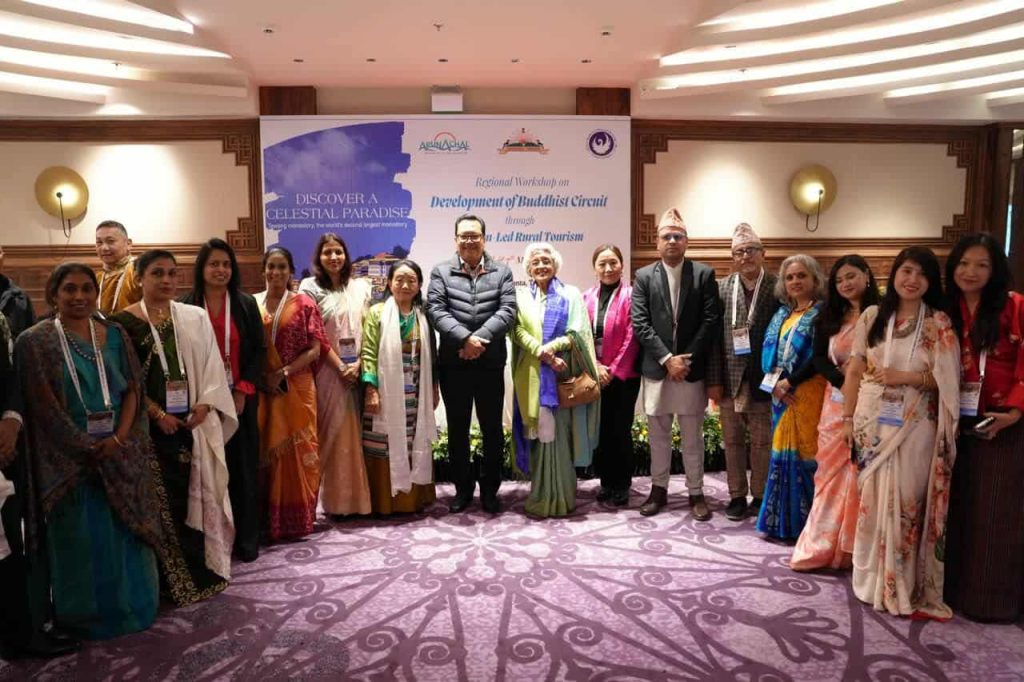
Tawang, Arunachal Pradesh, India | May 2026 , A landmark regional workshop focused on the development of an integrated Buddhist Circuit across South Asia through a women-led rural tourism model concluded successfully in Tawang, Arunachal Pradesh, India.
Held from May 6–7, the workshop brought together delegates from Nepal, Bhutan, Sri Lanka, and India to discuss sustainable, inclusive, and culturally rooted tourism development. The event was organized by the Department of Tourism, Government of Arunachal Pradesh, in collaboration with the South Asian Women’s Network (SWAN) and the Tawang District Administration.
The workshop was inaugurated in the presence of distinguished dignitaries, including Chowna Mein and Dasanglu Pul. Policymakers, tourism experts, women leaders, and stakeholders from across South Asia participated in deliberations aimed at strengthening regional cooperation, tourism connectivity, and sustainable tourism models centered on Buddhist heritage.
Focus on Women-Led Rural Tourism
A major highlight of the workshop was the emphasis on women-led rural tourism as a driver of sustainable development and community empowerment. Participants discussed the growing role of women as eco-guides, entrepreneurs, cultural interpreters, conservation advocates, and homestay operators.
The model aims to generate sustainable livelihoods while preserving local traditions, biodiversity, and cultural heritage across Buddhist destinations in South Asia.
Strengthening the Buddhist Circuit
Delegates stressed the importance of enhancing linkages among major Buddhist heritage sites across Nepal, India, Bhutan, and Sri Lanka, promoting the region as a unified spiritual and cultural tourism destination.
Discussions also focused on improving cross-border connectivity, infrastructure development, policy harmonization, and travel logistics to support seamless movement of tourists across the proposed circuit.
Participants further emphasized the need for sustainable tourism standards tailored to rural and ecotourism contexts, drawing upon international frameworks such as the Global Sustainable Tourism Criteria.
Nepal Delegation Highlights Wellness and Spiritual Tourism
The Nepal delegation was led by Yankila Sherpa and included representatives from the Nepal Tourism Board, International Development Institute (IDI), T-Help, Bar Pipal Bisauni Homestay, and Impact Adventure.
During the workshop, the Nepal delegation highlighted key Buddhist destinations in Nepal and underscored the importance of women-led tourism, destination connectivity, branding, and marketing.
A special presentation was delivered by Srijana Nepali on branding and marketing strategies for the Buddhist Circuit. She highlighted Nepal’s continued efforts to position itself as a leading destination for spiritual and wellness tourism through integrated promotional campaigns and strategic branding initiatives.
The presentation also emphasized Nepal’s growing focus on wellness tourism, including the observance of the 1st International Wellness Day on April 15, 2026, under the Nepal Wellness Year 2027 campaign. Buddhism was presented as a pathway to inner healing, mindfulness, and holistic wellbeing, positioning Nepal as a global hub for spiritual and wellness tourism.
Key Outcomes and Future Roadmap
The workshop concluded with a shared vision to establish the “Arc of Rural Tourism,” an integrated Buddhist Circuit connecting Nepal, Bhutan, Sri Lanka, Arunachal Pradesh, Sikkim, and Bihar through a women-led rural tourism framework.
Key recommendations and outcomes included:
Development of a transformative South Asian Buddhist Circuit linking major Buddhist destinations through sustainable and inclusive tourism models.
Promotion of peace, cultural exchange, and regional cooperation through shared Buddhist heritage.
Expansion of women’s economic participation through homestays, eco-tourism, handicrafts, gastronomy, and local entrepreneurship.
Implementation of a phased three-year action plan focusing on cross-border tourism corridors, digital tourism platforms, regional branding, policy coordination, and improved connectivity.
Positioning the Buddhist Circuit as a “Heritage Corridor for Peace” aimed at preserving Buddhist civilization while generating sustainable livelihoods and strengthening South Asian ties.
The outcomes and recommendations from the Tawang workshop are expected to guide future regional cooperation among Nepal, India, Bhutan, and Sri Lanka in advancing sustainable Buddhist tourism initiatives.
Organizers also announced that the next edition of the South Asia Women’s Conference will be hosted by Sri Lanka.


